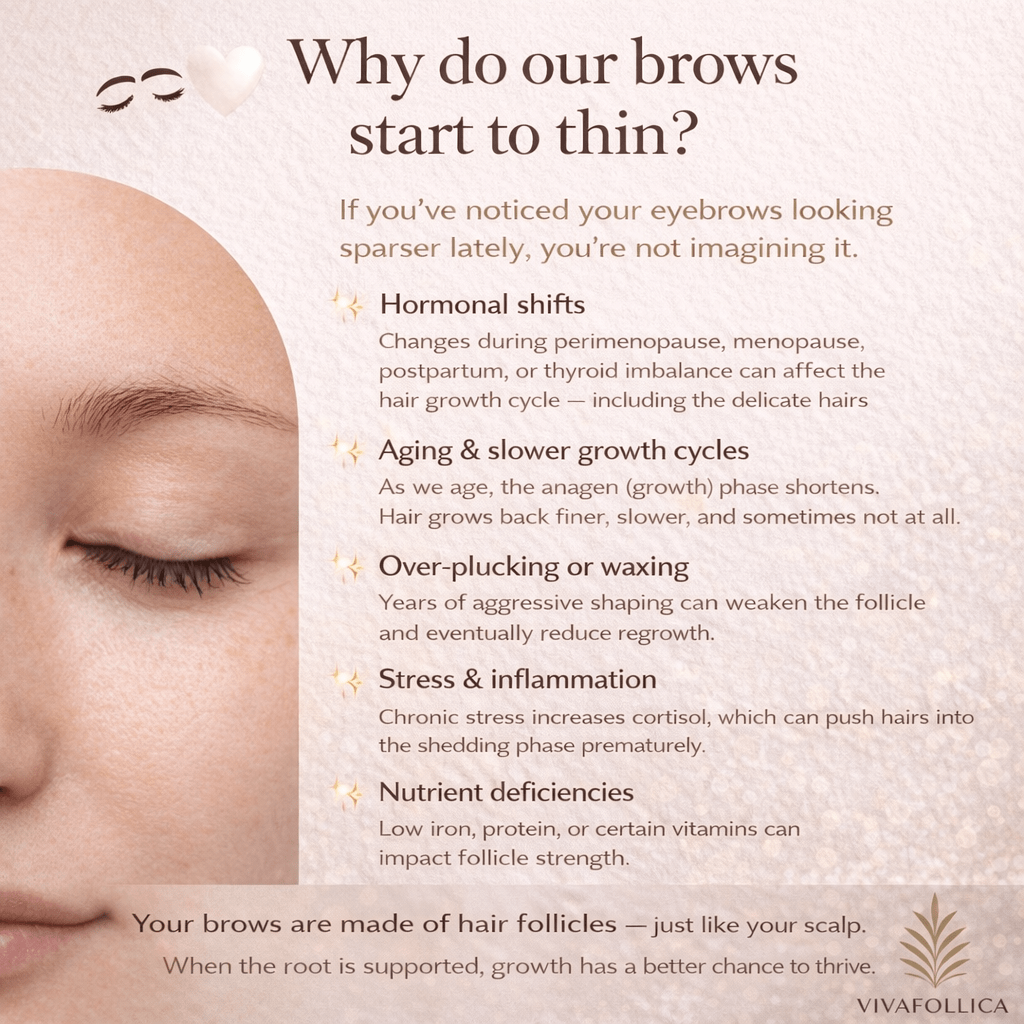
If you’ve noticed your eyebrows looking thinner, patchier, or slower to grow back, you’re not imagining it. Eyebrow thinning is more common than many people realize — and it can happen gradually, making it easy to dismiss at first.
Brows frame the face. When they begin to thin, it can feel unsettling. The good news? Understanding why eyebrow hair thins is the first step toward supporting healthy regrowth.
Let’s explore the most common causes of eyebrow thinning and what your body may be trying to tell you.
How Eyebrow Hair Growth Works
Just like scalp hair, eyebrow hair grows in cycles:
- Anagen (growth phase)
- Catagen (transition phase)
- Telogen (resting/shedding phase)
However, eyebrow hairs have a much shorter growth phase than scalp hair. That’s why they don’t grow as long. Because of this shorter cycle, disruptions — whether hormonal, nutritional, or stress-related — can show up more quickly in the brows.
When the growth cycle is shortened or follicles become weakened, brow hairs may grow back finer, slower, or not at all.
1. Hormonal Shifts and Eyebrow Thinning
One of the most common reasons for thinning eyebrows is hormonal fluctuation.
Changes during:
- Perimenopause
- Menopause
- Postpartum
- Thyroid imbalance
- Chronic stress
can all impact the hair growth cycle.
Estrogen helps keep hair in its growth phase. When estrogen declines — especially during midlife — hairs may enter the shedding phase earlier. Testosterone changes can also influence hair density and distribution.
Thyroid health plays a particularly important role. Hypothyroidism is classically associated with thinning at the outer third of the eyebrows. If brow thinning appears alongside fatigue, weight changes, or dry skin, thyroid testing may be worth discussing with a physician.
2. Aging and Slower Growth Cycles
As we age, hair follicles naturally change.
The anagen (growth) phase shortens. Follicles may shrink slightly. Hair grows back finer. In some cases, follicles become dormant.
This is not a failure of care — it’s biology.
However, while aging is natural, supporting circulation, nutrition, and scalp health can help maintain stronger follicle function over time.
3. Over-Plucking or Waxing
For many people, eyebrow thinning can be traced back to years of shaping trends.
Repeated plucking, threading, or waxing can cause:
- Trauma to the follicle
- Inflammation
- Gradual weakening of regrowth
- Permanent follicle damage in some cases
Hair follicles are resilient — but they’re not invincible. When repeatedly stressed, some may stop producing hair altogether.
If over-plucking is part of the picture, patience becomes essential. It can take several months for follicles to reset, and not all may fully recover.
4. Stress and Inflammation
Chronic stress impacts nearly every system in the body — including hair growth.
Elevated cortisol levels can push hair into the telogen (shedding) phase prematurely. This condition, known as telogen effluvium, can affect both scalp and eyebrow hair.
Additionally, systemic inflammation can impair nutrient delivery to follicles. When the body is in survival mode, non-essential functions like hair growth are deprioritized.
Signs stress may be contributing include:
- Increased shedding
- Thinning across multiple areas
- Fatigue
- Sleep disruption
Supporting nervous system regulation and reducing inflammation can make a meaningful difference in long-term hair health.
5. Nutrient Deficiencies and Brow Hair Loss
Hair is not essential for survival — which means when nutrients are limited, the body diverts resources elsewhere.
Common deficiencies linked to eyebrow thinning include:
- Iron
- Protein
- Zinc
- Vitamin D
- B vitamins
Even mild deficiencies can influence hair strength and density. If brow thinning feels sudden or accompanied by overall fatigue or brittle nails, nutrient testing may be helpful.
Hair follicles require consistent nourishment. Without it, regrowth slows.
Why Healthy Follicles Matter
Your eyebrows are made of hair follicles — just like your scalp.
Healthy follicles depend on:
- Adequate blood flow
- Balanced hormones
- Low inflammation
- Nutrient availability
- Gentle handling
When the root is supported, growth has a better chance to thrive.
Focusing only on the surface (like makeup or cosmetic fillers) may camouflage thinning, but it does not address the underlying environment of the follicle itself.
Can Thinning Eyebrows Grow Back?
In many cases, yes.
If follicles are still active and not permanently damaged, supporting internal and external health can improve regrowth.
However, regrowth takes time. Eyebrow hair grows slowly — often just a few millimeters per month. Visible improvement may require consistent care over several months.
Patience and realistic expectations are key.
When to See a Doctor
Consider medical evaluation if eyebrow thinning is:
- Sudden
- Rapid
- Accompanied by scalp hair loss
- Paired with fatigue or other systemic symptoms
- Associated with known thyroid disease
While many cases are benign and age-related, ruling out underlying conditions provides clarity and peace of mind.
A Holistic Approach to Brow Health
Thinning eyebrows are rarely random. They are often a signal — of stress, hormonal change, nutrient imbalance, or follicle fatigue.
Rather than reacting with panic, approach it with curiosity.
Support the root. Nourish the body. Reduce inflammation. Manage stress. Avoid further trauma to the follicle.
Growth is not just cosmetic — it reflects internal balance.
If your brows are thinning, you are not alone. And you are not imagining it.
Hair changes over time. Hormones shift. Stress accumulates. Follicles respond.
The goal is not perfection. It is support.
When the environment around the follicle improves, growth has the opportunity to follow.
Because healthy hair — whether on your scalp or your brows — always begins at the root.
 VivaFollica