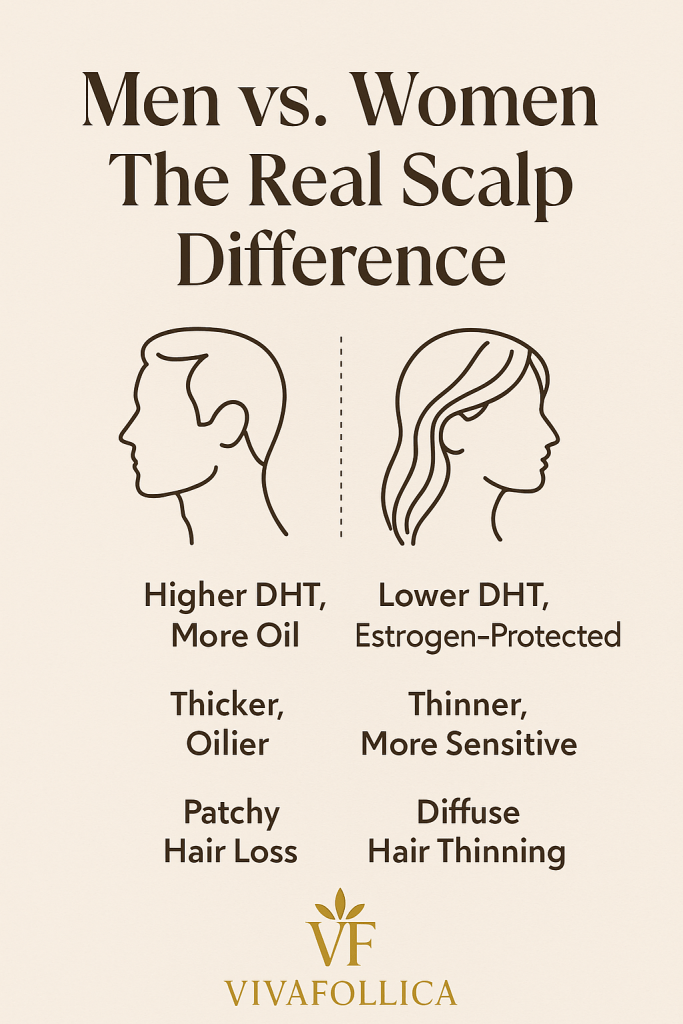
Yes, there are some key biological differences between men’s and women’s scalps, even though they share the same basic structure. These differences explain why men and women often experience different hair thinning patterns, oil production, and scalp needs.
Here’s a simple breakdown 👇
1. Hormonal Differences (The Biggest Factor)
The biggest difference between men’s and women’s scalps comes from hormones — especially androgens like testosterone and its more potent form, DHT (dihydrotestosterone).
- Men: Have higher levels of DHT, which binds to hair follicles (especially around the crown and hairline) and gradually shrinks them — a process called miniaturization. This is why men typically experience receding hairlines and bald spots.
- Women: Also have DHT, but in much lower amounts. Estrogen helps balance it out, protecting follicles longer. When estrogen drops (after pregnancy or during menopause), women may see diffuse thinning instead of patchy baldness.
💬 So, men’s hair loss tends to be concentrated in specific areas, while women’s is usually more spread out.
2. Oil (Sebum) Production
Men’s scalps generally produce more sebum (oil) than women’s — up to 50% more in some studies.
- Men’s scalps: Tend to be oilier, which can lead to clogged pores, buildup, or scalp acne if not washed regularly.
- Women’s scalps: Usually stay more balanced but can fluctuate due to hormonal changes, stress, or overuse of styling products.
💡 This is why men often prefer lightweight, purifying scalp care, while women may need more balancing and hydrating formulas.
3. Skin Thickness and Sensitivity
- Men’s scalps are typically thicker and have larger pores, which helps with oil flow but can also hold onto buildup.
- Women’s scalps tend to be thinner and more sensitive, meaning harsh ingredients (like sulfates or alcohols) can cause irritation more easily.
That’s why women’s scalp care often focuses on gentle nourishment and barrier repair — especially with serums that contain soothing ingredients like Niacinamide, Panthenol, or botanical extracts.
4. Hair Follicle Density and Growth Cycle
- Both men and women are born with roughly 100,000 hair follicles, but follicle density (how close together they are) and growth cycles differ slightly.
- Men’s follicles can have shorter growth (anagen) phases due to DHT influence, meaning hair cycles faster and sheds sooner.
- Women’s follicles usually stay in the growth phase longer, which is why women’s hair often grows longer before shedding.
5. Hair Loss Patterns
| Feature | Men | Women |
|---|---|---|
| Common pattern | Receding hairline, thinning crown | Widening part, diffuse thinning |
| Hormone involved | High DHT | DHT + Low estrogen |
| When it begins | Often in 20s–30s | Usually after 40s or post-pregnancy |
| Reversible? | Partially | Often treatable if follicles stay active |
6. Scalp Care Needs
Because of these differences, ideal scalp care routines aren’t always the same.
For Men:
- Use clarifying or balancing shampoos to manage excess oil and buildup.
- Add DHT-blocking ingredients like Capixyl, Redensyl, or saw palmetto.
- Exfoliate weekly to keep follicles clear.
For Women:
- Use hydrating, gentle cleansers that preserve scalp moisture.
- Support hormonal balance and follicle strength with ingredients like Fo-Ti Root, Niacinamide, and caffeine.
- Avoid harsh chemicals or tight hairstyles that stress the follicles.
7. Shared Truth: Healthy Hair Starts with the Scalp
Even though there are differences, one thing is true for both men and women:
The scalp is skin — and healthy hair begins with healthy skin.
Whether it’s controlling oil, soothing irritation, or boosting circulation, both men and women benefit from consistent scalp care that includes:
- Regular cleansing (to remove buildup)
- Gentle exfoliation
- Daily nourishment (like a growth serum)
- Stress management and balanced nutrition
💜 In Summary
| Aspect | Men’s Scalp | Women’s Scalp |
|---|---|---|
| Hormones | Higher DHT, more oil | Lower DHT, estrogen-protected |
| Skin type | Thicker, oilier | Thinner, more sensitive |
| Hair loss | Patchy (crown/hairline) | Diffuse (crown/part line) |
| Care needs | Clarifying, anti-DHT | Hydrating, hormone-supportive |
Vivafollica’s Approach
At Vivafollica, we design formulas that respect both biology and balance. Our growth serum, powered by Redensyl, Capixyl, Fo-Ti Root, and Niacinamide, targets the root cause of thinning while maintaining scalp health for both men and women.
Our mission: Where science meets nature — for every scalp. 💜
 VivaFollica
Leave a comment