Not all hair grows the same way—and that’s a beautiful thing.
From sleek straight strands to tight coils, every hair texture has its own growth pattern, structure, strengths, and challenges. Understanding how different hair types grow can help you care for your scalp and strands more effectively—and set realistic expectations about length, density, and growth speed.
At the heart of it all? The scalp.
Because no matter your texture, healthy growth always begins at the root.
The Basics of Hair Growth
Before diving into texture differences, let’s quickly review how hair grows.
Hair grows in cycles:
- Anagen (growth phase) – Lasts 2–7 years
- Catagen (transition phase) – Short resting period
- Telogen (shedding phase) – Hair releases and new growth begins
The length of your anagen phase largely determines how long your hair can grow. Genetics play a major role—but texture influences how that growth appears and behaves.
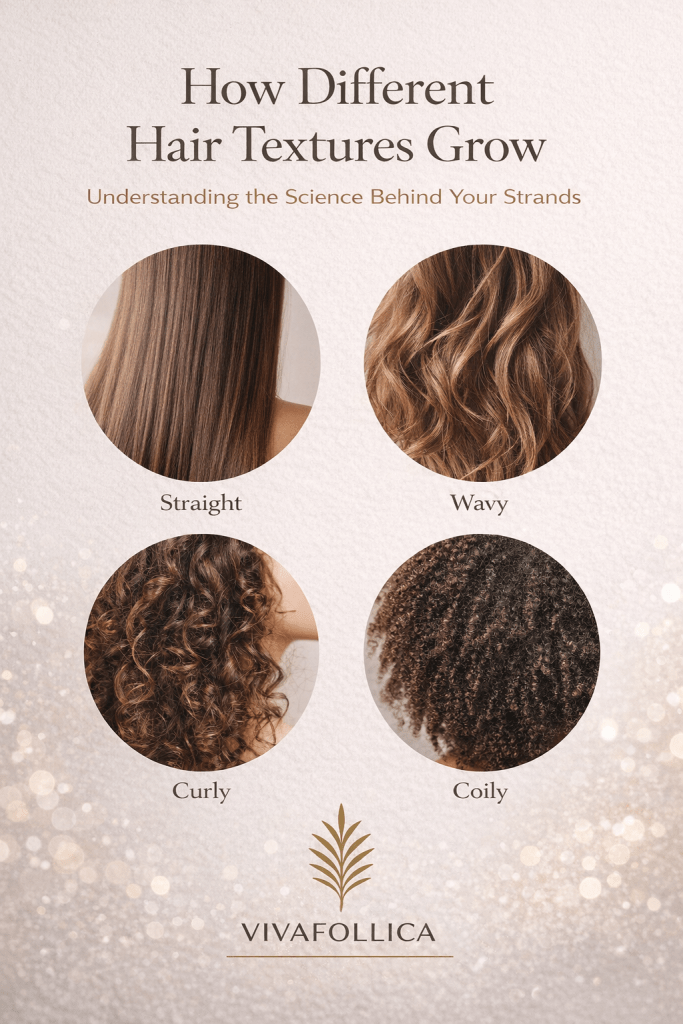
Straight Hair (Type 1)
Straight hair tends to grow in a direct, downward pattern from a round follicle shape.
Growth Characteristics:
- Often appears to grow faster
- Natural oils travel easily from scalp to ends
- Typically reflects more shine
- More prone to visible oil buildup at the roots
Because the follicle is round and smooth, sebum (your scalp’s natural oil) can glide down the strand more easily. This keeps hair naturally conditioned but may require more frequent washing.
Straight hair may appear to grow faster, but in reality, it simply shows length more visibly because it doesn’t shrink or coil.
Wavy Hair (Type 2)
Wavy hair grows from slightly oval-shaped follicles, creating loose S-pattern bends.
Growth Characteristics:
- Moderate oil distribution
- Can be prone to frizz
- May appear fuller due to texture
- Can fluctuate between oily scalp and dry ends
Wavy hair often grows at a similar rate to straight hair but may look shorter depending on how defined the waves are. Managing moisture balance is key, especially in changing climates.
Curly Hair (Type 3)
Curly hair grows from more oval-shaped follicles and forms defined spirals.
Growth Characteristics:
- Natural shrinkage (can look 25–50% shorter than actual length)
- More fragile at bend points
- Slower visible length retention
- Scalp oils have a harder time reaching the ends
Curly hair doesn’t necessarily grow slower—but it may retain length differently. Because curls bend and twist, the strand experiences more stress along its structure. Breakage can interrupt visible growth.
Moisture and gentle handling are especially important for maintaining strength.
Coily / Kinky Hair (Type 4)
Coily hair grows from very flat or elliptical follicles, forming tight zig-zag or spiral patterns.
Growth Characteristics:
- Significant shrinkage (up to 75%)
- Most fragile texture due to tight bends
- Slower oil distribution from scalp
- Highly prone to dryness
Coily hair often appears to grow slowly, but the growth rate at the scalp is similar to other textures. The difference lies in:
- Shrinkage
- Breakage
- Moisture retention
Because coils are tightly structured, the strand’s natural weak points increase. Gentle scalp care and consistent hydration are essential for length retention.
Does Texture Affect Growth Speed?
Genetically, most hair grows about ½ inch per month, regardless of texture.
However, texture can influence:
- How long hair remains in the growth phase
- How easily strands break
- How visible length appears
- How well moisture is retained
For example:
- Straight hair may appear longer faster.
- Coily hair may grow at the same rate but experience shrinkage and breakage that mask growth.
This is why comparing hair journeys across textures can be misleading.
The Role of Scalp Health Across All Textures
No matter your hair type, growth begins beneath the surface.
Healthy follicles depend on:
- Balanced scalp hydration
- Strong circulation
- Reduced inflammation
- Adequate nutrients
- Low chronic stress
Textured hair types (especially curly and coily) often need more intentional scalp care because oils don’t distribute as easily along the strand. That makes root-level nourishment even more important.
When the scalp barrier is compromised—whether from dryness, buildup, or irritation—growth cycles can be disrupted across all textures.
Environmental Factors Matter Too
Climate plays a major role in how different textures behave.
- Cold weather can dry out curly and coily textures quickly.
- Humidity can cause frizz in wavy and curly hair.
- Heat styling affects finer straight textures more rapidly.
- Protective styling can help textured hair retain length when done gently.
Understanding your texture helps you adapt your routine seasonally.
Why Length Retention Is the Real Goal
For many people, the question isn’t “Why isn’t my hair growing?” but rather, “Why can’t I keep the length I grow?”
Breakage, dryness, and friction often prevent visible progress—especially in tighter textures.
Length retention improves when:
- The scalp is supported consistently
- Strands are handled gently
- Moisture levels are balanced
- Tension and friction are minimized
Healthy growth is a long game—not a quick fix.
Embracing Your Texture
Each hair texture carries its own beauty, structure, and growth rhythm.
Straight hair may reflect shine effortlessly.
Waves bring volume and movement.
Curls add dimension and personality.
Coils offer incredible versatility and strength.
Understanding how your hair grows allows you to work with it, not against it.
When you stop comparing textures and start supporting your own scalp environment, growth becomes less mysterious—and more manageable.
Different hair textures don’t grow “better” or “worse”—they simply grow differently.
The key isn’t chasing someone else’s pattern. It’s supporting your own scalp, respecting your strand structure, and nurturing your growth cycle consistently.
Because when the scalp thrives, every texture has the potential to grow strong, resilient, and beautiful.
 VivaFollica
Leave a comment