Tag: hair-growth-serum

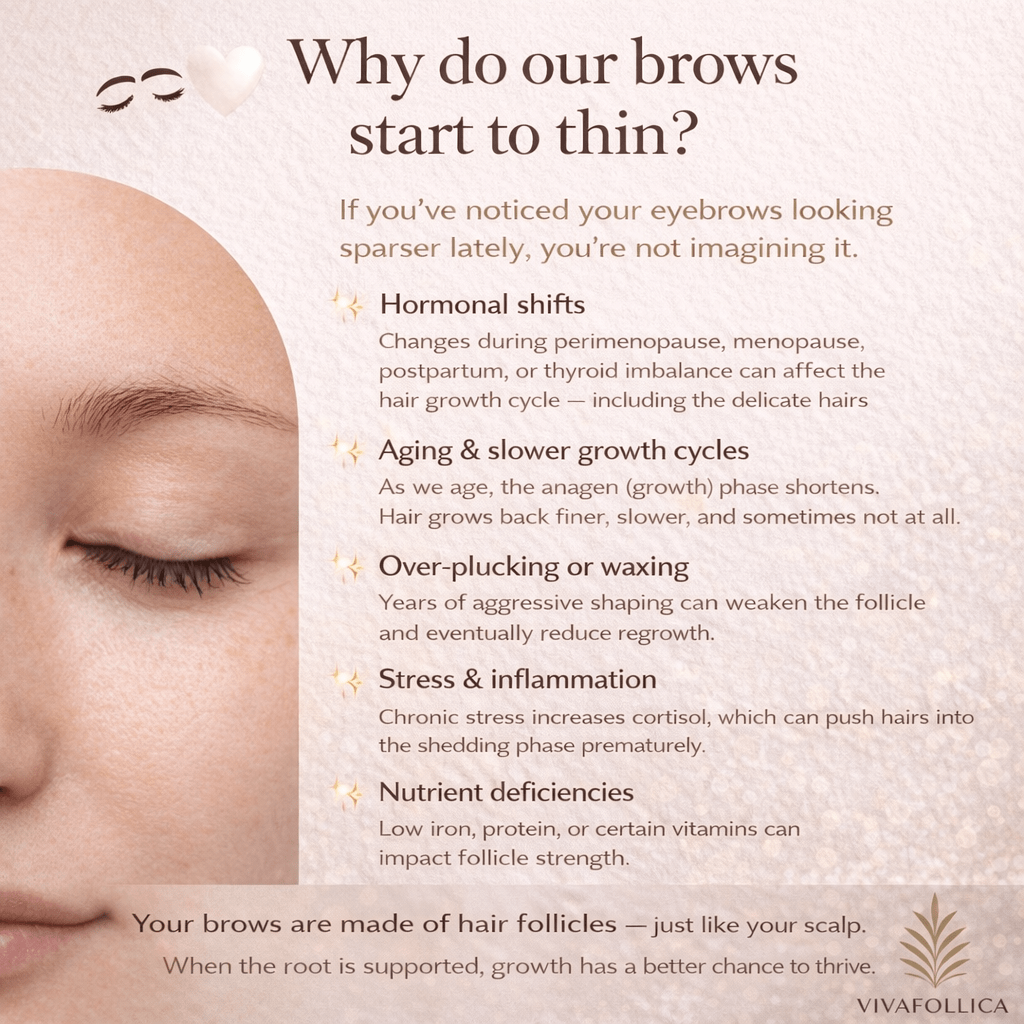
  • Why Are My Eyebrows Thinning? Understanding the Real Causes of Brow Hair Loss

    If you’ve noticed your eyebrows looking thinner, patchier, or slower to grow back, you’re not imagining it. Eyebrow thinning is more common than many people realize — and it can happen gradually, making it easy to dismiss at first.

    Brows frame the face. When they begin to thin, it can feel unsettling. The good news? Understanding why eyebrow hair thins is the first step toward supporting healthy regrowth.

    Let’s explore the most common causes of eyebrow thinning and what your body may be trying to tell you.

    How Eyebrow Hair Growth Works

    Just like scalp hair, eyebrow hair grows in cycles:

    • Anagen (growth phase)
    • Catagen (transition phase)
    • Telogen (resting/shedding phase)

    However, eyebrow hairs have a much shorter growth phase than scalp hair. That’s why they don’t grow as long. Because of this shorter cycle, disruptions — whether hormonal, nutritional, or stress-related — can show up more quickly in the brows.

    When the growth cycle is shortened or follicles become weakened, brow hairs may grow back finer, slower, or not at all.

    1. Hormonal Shifts and Eyebrow Thinning

    One of the most common reasons for thinning eyebrows is hormonal fluctuation.

    Changes during:

    • Perimenopause
    • Menopause
    • Postpartum
    • Thyroid imbalance
    • Chronic stress

    can all impact the hair growth cycle.

    Estrogen helps keep hair in its growth phase. When estrogen declines — especially during midlife — hairs may enter the shedding phase earlier. Testosterone changes can also influence hair density and distribution.

    Thyroid health plays a particularly important role. Hypothyroidism is classically associated with thinning at the outer third of the eyebrows. If brow thinning appears alongside fatigue, weight changes, or dry skin, thyroid testing may be worth discussing with a physician.

    2. Aging and Slower Growth Cycles

    As we age, hair follicles naturally change.

    The anagen (growth) phase shortens. Follicles may shrink slightly. Hair grows back finer. In some cases, follicles become dormant.

    This is not a failure of care — it’s biology.

    However, while aging is natural, supporting circulation, nutrition, and scalp health can help maintain stronger follicle function over time.

    3. Over-Plucking or Waxing

    For many people, eyebrow thinning can be traced back to years of shaping trends.

    Repeated plucking, threading, or waxing can cause:

    • Trauma to the follicle
    • Inflammation
    • Gradual weakening of regrowth
    • Permanent follicle damage in some cases

    Hair follicles are resilient — but they’re not invincible. When repeatedly stressed, some may stop producing hair altogether.

    If over-plucking is part of the picture, patience becomes essential. It can take several months for follicles to reset, and not all may fully recover.

    4. Stress and Inflammation

    Chronic stress impacts nearly every system in the body — including hair growth.

    Elevated cortisol levels can push hair into the telogen (shedding) phase prematurely. This condition, known as telogen effluvium, can affect both scalp and eyebrow hair.

    Additionally, systemic inflammation can impair nutrient delivery to follicles. When the body is in survival mode, non-essential functions like hair growth are deprioritized.

    Signs stress may be contributing include:

    • Increased shedding
    • Thinning across multiple areas
    • Fatigue
    • Sleep disruption

    Supporting nervous system regulation and reducing inflammation can make a meaningful difference in long-term hair health.

    5. Nutrient Deficiencies and Brow Hair Loss

    Hair is not essential for survival — which means when nutrients are limited, the body diverts resources elsewhere.

    Common deficiencies linked to eyebrow thinning include:

    • Iron
    • Protein
    • Zinc
    • Vitamin D
    • B vitamins

    Even mild deficiencies can influence hair strength and density. If brow thinning feels sudden or accompanied by overall fatigue or brittle nails, nutrient testing may be helpful.

    Hair follicles require consistent nourishment. Without it, regrowth slows.

    Why Healthy Follicles Matter

    Your eyebrows are made of hair follicles — just like your scalp.

    Healthy follicles depend on:

    • Adequate blood flow
    • Balanced hormones
    • Low inflammation
    • Nutrient availability
    • Gentle handling

    When the root is supported, growth has a better chance to thrive.

    Focusing only on the surface (like makeup or cosmetic fillers) may camouflage thinning, but it does not address the underlying environment of the follicle itself.

    Can Thinning Eyebrows Grow Back?

    In many cases, yes.

    If follicles are still active and not permanently damaged, supporting internal and external health can improve regrowth.

    However, regrowth takes time. Eyebrow hair grows slowly — often just a few millimeters per month. Visible improvement may require consistent care over several months.

    Patience and realistic expectations are key.

    When to See a Doctor

    Consider medical evaluation if eyebrow thinning is:

    • Sudden
    • Rapid
    • Accompanied by scalp hair loss
    • Paired with fatigue or other systemic symptoms
    • Associated with known thyroid disease

    While many cases are benign and age-related, ruling out underlying conditions provides clarity and peace of mind.

    A Holistic Approach to Brow Health

    Thinning eyebrows are rarely random. They are often a signal — of stress, hormonal change, nutrient imbalance, or follicle fatigue.

    Rather than reacting with panic, approach it with curiosity.

    Support the root. Nourish the body. Reduce inflammation. Manage stress. Avoid further trauma to the follicle.

    Growth is not just cosmetic — it reflects internal balance.

    If your brows are thinning, you are not alone. And you are not imagining it.

    Hair changes over time. Hormones shift. Stress accumulates. Follicles respond.

    The goal is not perfection. It is support.

    When the environment around the follicle improves, growth has the opportunity to follow.

    Because healthy hair — whether on your scalp or your brows — always begins at the root.
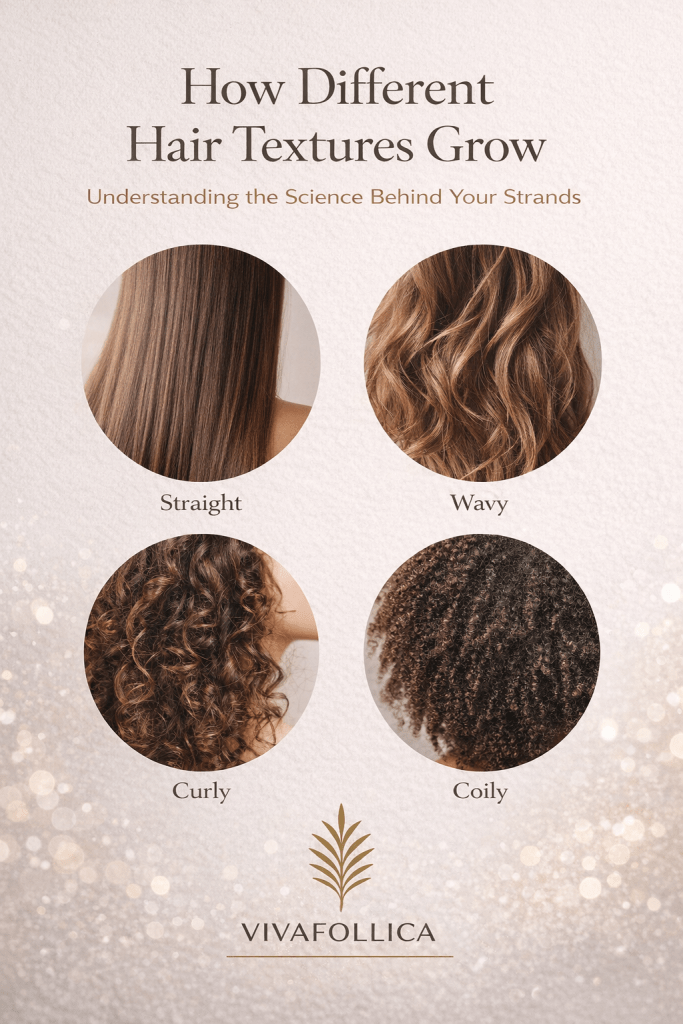
  • How Different Hair Textures Grow: Understanding the Science Behind Your Strands

    Not all hair grows the same way—and that’s a beautiful thing.

    From sleek straight strands to tight coils, every hair texture has its own growth pattern, structure, strengths, and challenges. Understanding how different hair types grow can help you care for your scalp and strands more effectively—and set realistic expectations about length, density, and growth speed.

    At the heart of it all? The scalp.

    Because no matter your texture, healthy growth always begins at the root.

    The Basics of Hair Growth

    Before diving into texture differences, let’s quickly review how hair grows.

    Hair grows in cycles:

    • Anagen (growth phase) – Lasts 2–7 years
    • Catagen (transition phase) – Short resting period
    • Telogen (shedding phase) – Hair releases and new growth begins

    The length of your anagen phase largely determines how long your hair can grow. Genetics play a major role—but texture influences how that growth appears and behaves.

    Straight Hair (Type 1)

    Straight hair tends to grow in a direct, downward pattern from a round follicle shape.

    Growth Characteristics:

    • Often appears to grow faster
    • Natural oils travel easily from scalp to ends
    • Typically reflects more shine
    • More prone to visible oil buildup at the roots

    Because the follicle is round and smooth, sebum (your scalp’s natural oil) can glide down the strand more easily. This keeps hair naturally conditioned but may require more frequent washing.

    Straight hair may appear to grow faster, but in reality, it simply shows length more visibly because it doesn’t shrink or coil.

    Wavy Hair (Type 2)

    Wavy hair grows from slightly oval-shaped follicles, creating loose S-pattern bends.

    Growth Characteristics:

    • Moderate oil distribution
    • Can be prone to frizz
    • May appear fuller due to texture
    • Can fluctuate between oily scalp and dry ends

    Wavy hair often grows at a similar rate to straight hair but may look shorter depending on how defined the waves are. Managing moisture balance is key, especially in changing climates.

    Curly Hair (Type 3)

    Curly hair grows from more oval-shaped follicles and forms defined spirals.

    Growth Characteristics:

    • Natural shrinkage (can look 25–50% shorter than actual length)
    • More fragile at bend points
    • Slower visible length retention
    • Scalp oils have a harder time reaching the ends

    Curly hair doesn’t necessarily grow slower—but it may retain length differently. Because curls bend and twist, the strand experiences more stress along its structure. Breakage can interrupt visible growth.

    Moisture and gentle handling are especially important for maintaining strength.

    Coily / Kinky Hair (Type 4)

    Coily hair grows from very flat or elliptical follicles, forming tight zig-zag or spiral patterns.

    Growth Characteristics:

    • Significant shrinkage (up to 75%)
    • Most fragile texture due to tight bends
    • Slower oil distribution from scalp
    • Highly prone to dryness

    Coily hair often appears to grow slowly, but the growth rate at the scalp is similar to other textures. The difference lies in:

    1. Shrinkage
    2. Breakage
    3. Moisture retention

    Because coils are tightly structured, the strand’s natural weak points increase. Gentle scalp care and consistent hydration are essential for length retention.

    Does Texture Affect Growth Speed?

    Genetically, most hair grows about ½ inch per month, regardless of texture.

    However, texture can influence:

    • How long hair remains in the growth phase
    • How easily strands break
    • How visible length appears
    • How well moisture is retained

    For example:

    • Straight hair may appear longer faster.
    • Coily hair may grow at the same rate but experience shrinkage and breakage that mask growth.

    This is why comparing hair journeys across textures can be misleading.

    The Role of Scalp Health Across All Textures

    No matter your hair type, growth begins beneath the surface.

    Healthy follicles depend on:

    • Balanced scalp hydration
    • Strong circulation
    • Reduced inflammation
    • Adequate nutrients
    • Low chronic stress

    Textured hair types (especially curly and coily) often need more intentional scalp care because oils don’t distribute as easily along the strand. That makes root-level nourishment even more important.

    When the scalp barrier is compromised—whether from dryness, buildup, or irritation—growth cycles can be disrupted across all textures.

    Environmental Factors Matter Too

    Climate plays a major role in how different textures behave.

    • Cold weather can dry out curly and coily textures quickly.
    • Humidity can cause frizz in wavy and curly hair.
    • Heat styling affects finer straight textures more rapidly.
    • Protective styling can help textured hair retain length when done gently.

    Understanding your texture helps you adapt your routine seasonally.

    Why Length Retention Is the Real Goal

    For many people, the question isn’t “Why isn’t my hair growing?” but rather, “Why can’t I keep the length I grow?”

    Breakage, dryness, and friction often prevent visible progress—especially in tighter textures.

    Length retention improves when:

    • The scalp is supported consistently
    • Strands are handled gently
    • Moisture levels are balanced
    • Tension and friction are minimized

    Healthy growth is a long game—not a quick fix.

    Embracing Your Texture

    Each hair texture carries its own beauty, structure, and growth rhythm.

    Straight hair may reflect shine effortlessly.
    Waves bring volume and movement.
    Curls add dimension and personality.
    Coils offer incredible versatility and strength.

    Understanding how your hair grows allows you to work with it, not against it.

    When you stop comparing textures and start supporting your own scalp environment, growth becomes less mysterious—and more manageable.

    Different hair textures don’t grow “better” or “worse”—they simply grow differently.

    The key isn’t chasing someone else’s pattern. It’s supporting your own scalp, respecting your strand structure, and nurturing your growth cycle consistently.

    Because when the scalp thrives, every texture has the potential to grow strong, resilient, and beautiful.

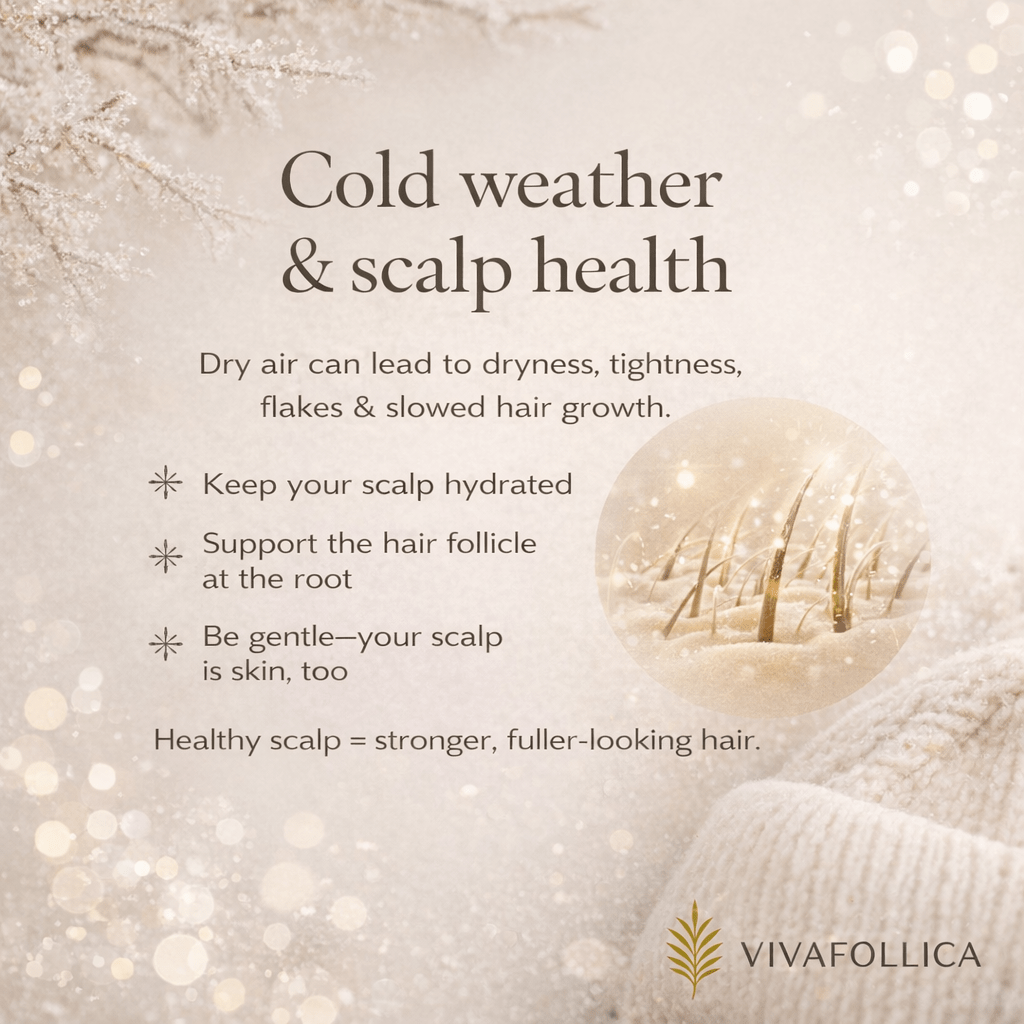
  • Cold Weather & Scalp Health: Why Winter Can Slow Your Hair Growth (and What to Do About It)

    When temperatures drop, most people instinctively switch up their skincare—richer creams, gentler cleansers, extra hydration. But one area is often overlooked during colder months: the scalp.

    Just like the skin on your face, your scalp is living tissue. It responds to environmental changes, reacts to stress, and plays a critical role in the strength, density, and appearance of your hair. In winter, cold air, low humidity, and indoor heating can quietly disrupt scalp balance, creating the perfect conditions for dryness, irritation, and even slowed hair growth.

    At Vivafollica, we believe that healthy hair starts at the root—literally. Understanding how cold weather affects the scalp is the first step toward protecting your hair year-round.

    How Cold Weather Impacts the Scalp

    Winter creates a unique set of challenges for scalp health. Outside, cold air holds very little moisture. Inside, heaters further strip humidity from the environment. This double hit often leads to:

    • Dryness and tightness
      Reduced moisture weakens the scalp’s natural barrier, making it feel tight, itchy, or uncomfortable.
    • Flaking and irritation
      A dry scalp may begin to shed skin cells more visibly, often mistaken for dandruff.
    • Reduced circulation
      Cold temperatures can cause blood vessels to constrict. When scalp circulation slows, less oxygen and fewer nutrients reach the hair follicle.
    • Slower hair growth cycles
      Hair follicles thrive in a balanced, nourished environment. When the scalp is inflamed or dehydrated, growth can stall and shedding may increase.

    Over time, these factors can affect hair density, strength, and overall vitality—especially for those already experiencing thinning or sensitivity.

    Why Scalp Health Is the Foundation of Hair Growth

    Hair growth doesn’t begin with strands—it begins with follicles embedded in the scalp. Each follicle relies on adequate blood flow, nutrients, and a calm, hydrated environment to function optimally.

    When the scalp barrier is compromised, follicles may shift prematurely into a resting phase. This can result in:

    • Increased shedding
    • Finer, weaker regrowth
    • Hair that appears dull or sparse

    Supporting the scalp during winter isn’t just about comfort—it’s about maintaining the conditions necessary for long-term hair health.

    Common Winter Hair Habits That Can Make Things Worse

    Well-intentioned habits can sometimes worsen scalp stress during colder months:

    • Over-washing in an attempt to remove flakes, which strips natural oils
    • Very hot showers, which further dehydrate the scalp
    • Tight hats or beanies that trap sweat and friction without scalp care beneath
    • Ignoring hydration, assuming hair products alone are enough

    A gentle, scalp-first routine is key.

    How to Support Scalp Health During Cold Weather

    Protecting your scalp in winter doesn’t require an overhaul—just thoughtful adjustments.

    1. Prioritize Scalp Hydration

    Hydration isn’t only about drinking water. The scalp benefits from targeted, lightweight hydration that supports the skin barrier without clogging follicles. Look for formulations designed specifically for the scalp—not heavy oils meant for hair lengths.

    2. Support Circulation at the Root

    Healthy circulation helps deliver oxygen and nutrients to hair follicles. Gentle scalp massage, whether with fingertips or a soft tool, can encourage blood flow and reduce tension caused by cold-weather constriction.

    3. Be Gentle—Your Scalp Is Skin

    Treat your scalp the way you treat facial skin. Avoid harsh scrubs, aggressive brushing, or frequent product switching. Consistency and gentleness go a long way.

    4. Protect Without Suffocating

    Hats and scarves are winter essentials, but wearing them over an already dry or irritated scalp can worsen discomfort. Supporting scalp health underneath ensures protection doesn’t come at a cost.

    Why Winter Is the Best Time to Invest in Scalp Care

    Many people wait until hair thinning becomes visible to take action—but winter is actually the ideal season to be proactive.

    Hair growth is gradual. Supporting follicles now helps set the stage for stronger, fuller-looking hair in the months ahead. Think of winter as preparation season—when nurturing the scalp pays dividends in spring and beyond.

    The Vivafollica Approach: Science-Driven, Scalp-First Care

    At Vivafollica, we believe hair wellness is built at the scalp level. Our philosophy blends science-backed ingredientswith a deep respect for the scalp as skin—not an afterthought.

    By focusing on hydration, follicle support, and scalp balance, Vivafollica helps maintain an environment where hair can thrive—even during the most challenging seasons.

    Healthy scalp conditions don’t hibernate. Neither should your hair goals.

    Cold weather may be unavoidable, but compromised scalp health doesn’t have to be. With mindful care, gentle support, and a scalp-first mindset, winter can become a season of restoration rather than setback.

    Because when your scalp is healthy, your hair has the foundation it needs to grow stronger, fuller, and more resilient—no matter the temperature.

  • Scalp Care at Home: The Foundation of Healthy Hair

    When it comes to hair health, most people focus on what they can see: shine, length, thickness, and styling. But the true foundation of healthy hair lies beneath it all — the scalp. Just as plants rely on nutrient-rich soil to grow, hair follicles depend on a balanced, well-cared-for scalp environment. Scalp care is not a trend; it is an essential part of hair wellness, and the good news is that you can build an effective scalp-care routine right at home.

    Why Scalp Care Matters

    Your scalp is living skin. It contains hair follicles, oil glands, blood vessels, and nerve endings that all work together to support hair growth. When the scalp is clogged, inflamed, overly dry, or excessively oily, follicles can become stressed. This may contribute to issues such as thinning, shedding, slow growth, itchiness, or flaking.

    Healthy hair doesn’t start in the shower or with styling tools — it starts with scalp health. By maintaining proper circulation, hydration, and cleanliness, you create the ideal conditions for stronger, fuller-looking hair over time.

    Common Scalp Issues at Home

    Many scalp concerns develop gradually and are often overlooked. Common issues include:

    • Product buildup from styling creams, dry shampoo, and oils
    • Dryness or flaking caused by overwashing or harsh cleansers
    • Excess oil production, often a response to stripping shampoos
    • Poor circulation, which can limit nutrient delivery to follicles
    • Sensitivity or inflammation due to environmental stressors or irritation

    Understanding your scalp type — dry, oily, balanced, or sensitive — is the first step toward caring for it properly.

    Step 1: Cleanse Gently and Intentionally

    Cleansing the scalp is essential, but more is not always better. Overwashing or using aggressive shampoos can disrupt the scalp’s natural barrier, leading to irritation and rebound oil production.

    Choose a gentle, sulfate-free shampoo that cleans without stripping. Focus application on the scalp rather than the lengths of the hair, and use your fingertips (not nails) to massage lightly. This removes buildup while stimulating circulation.

    For many people, washing two to four times per week is sufficient. The goal is balance — a clean scalp that still retains its natural moisture.

    Step 2: Exfoliate to Remove Buildup

    Just like facial skin, the scalp benefits from regular exfoliation. Dead skin cells, excess oil, and product residue can block follicles and interfere with healthy growth.

    Scalp exfoliation can be done once a week using a gentle chemical exfoliant (such as salicylic acid or fruit enzymes) or a mild physical scrub designed specifically for the scalp. Avoid harsh scrubs or DIY mixtures that may cause micro-tears.

    Exfoliating helps reset the scalp, improves absorption of treatments, and leaves the scalp feeling refreshed and breathable.

    Step 3: Massage for Circulation

    Scalp massage is one of the simplest yet most powerful tools for scalp care at home. Massaging increases blood flow to the follicles, delivering oxygen and nutrients that support healthy hair growth.

    You can massage your scalp with clean fingertips, a silicone scalp brush, or even during shampooing. Just five minutes a day can make a difference. Massage also helps relieve tension, reduce stress, and promote relaxation — all of which indirectly benefit hair health.

    Step 4: Hydrate and Nourish the Scalp

    A healthy scalp needs moisture, just like the rest of your skin. Lightweight scalp serums or treatments can help hydrate without clogging pores or weighing hair down.

    Look for ingredients that support scalp health, such as:

    • Niacinamide for barrier support
    • Botanical extracts for soothing
    • Peptides or plant-based actives that support follicles
    • Antioxidants to protect against environmental stress

    Apply treatments directly to the scalp and massage gently. Consistency matters more than quantity.

    Step 5: Protect the Scalp Daily

    Scalp care doesn’t end after washing. Daily habits play a major role in scalp health.

    • Avoid excessive heat from blow dryers and hot tools
    • Protect your scalp from sun exposure with hats or UV sprays
    • Limit tight hairstyles that pull on follicles
    • Wash brushes and tools regularly to prevent bacteria buildup

    Your scalp is exposed to the same environmental stressors as your face — pollution, UV rays, and temperature changes — so protection is key.

    Step 6: Support Scalp Health from Within

    External care works best when paired with internal support. Hydration, nutrition, sleep, and stress management all influence scalp and hair health.

    Drink enough water, prioritize protein and micronutrients, and manage stress levels whenever possible. Chronic stress can disrupt hair growth cycles and affect scalp balance.

    Consistency Is the Secret

    Scalp care is not a one-time fix — it’s a long-term commitment. Results don’t happen overnight, but with consistent care, many people notice improvements in scalp comfort, hair texture, and overall hair vitality within weeks to months.

    Think of scalp care as skincare for your hair. When you nurture the foundation, everything that grows from it benefits.

    Healthy hair doesn’t begin with styling products or treatments for the ends — it begins at the root. By caring for your scalp at home through gentle cleansing, exfoliation, massage, hydration, and protection, you empower your hair to thrive naturally.

    When you shift your focus to scalp health, you’re not just caring for your hair — you’re investing in long-term hair wellness.

  • Why Hair Is So Important: More Than Just Appearance

    Hair is often dismissed as “just cosmetic,” but for most people, it represents something much deeper. It’s tied to identity, confidence, culture, health, and self-expression. When hair feels healthy, strong, and vibrant, it often reflects how we feel inside. When it doesn’t, it can quietly affect self-esteem, mood, and the way we show up in the world.

    Understanding why hair is so important helps shift the conversation from surface-level beauty to holistic care — and highlights why nurturing hair (starting at the scalp) truly matters.

    Hair as a Part of Identity

    From the way we style it to the way it grows naturally, hair is deeply personal. It reflects individuality, heritage, and even life stages. Across cultures and generations, hair has symbolized strength, femininity, freedom, spirituality, and status.

    For many people:

    • Hair represents youth and vitality
    • It’s a form of self-expression
    • It’s closely tied to confidence and self-image

    Changes in hair — whether thinning, shedding, dryness, or breakage — can feel unsettling because they impact how we recognize ourselves.

    The Emotional Impact of Hair Health

    Hair health affects more than appearance. When hair feels fragile or begins to thin, it can trigger emotional responses such as frustration, self-consciousness, or anxiety.

    This is especially true because hair changes are often gradual. You may notice more shedding in the shower, less volume at the roots, or slower growth over time. These subtle shifts can quietly impact confidence long before others notice anything at all.

    Healthy hair, on the other hand, often:

    • Boosts confidence
    • Encourages self-care rituals
    • Enhances how we feel day to day

    That’s why caring for hair isn’t vanity — it’s self-connection.

    Hair as a Reflection of Overall Health

    Hair is often considered a mirror of internal and external health. Stress, hormonal changes, nutrition, inflammation, and lifestyle habits all influence hair growth and quality.

    When the body is under stress, hair is often one of the first areas to show it. This is because hair growth is not a survival function — it thrives best when the body and scalp are supported.

    Common factors that affect hair health include:

    • Chronic stress
    • Hormonal fluctuations
    • Nutrient deficiencies
    • Inflammation
    • Scalp imbalance

    Supporting hair means supporting the environment it grows from — the scalp — and the body as a whole.

    Why the Scalp Matters So Much

    Hair doesn’t grow in isolation. Each strand emerges from a follicle embedded in the scalp, which is living skin with its own microbiome, circulation, and oil balance.

    When the scalp is healthy:

    • Follicles function more efficiently
    • Hair grows stronger and more resilient
    • The growth cycle remains balanced

    When the scalp is congested, inflamed, or neglected, hair growth can become compromised. This is why a scalp-first approach to hair care is essential — it creates the foundation for healthy hair over time.

    Hair and Confidence in Daily Life

    Hair is one of the first things we notice about ourselves in the mirror. It frames the face, influences style choices, and plays a role in how we present ourselves socially and professionally.

    Good hair days often translate into:

    • Increased confidence
    • Easier styling
    • Feeling more put together

    Struggling with hair issues, on the other hand, can make people feel less confident — even if they don’t consciously connect the two. This emotional connection is why gentle, intentional hair care matters so deeply.

    The Shift Toward Intentional Hair Care

    The conversation around hair care is evolving. Instead of quick fixes and harsh treatments, there is a growing focus on long-term hair wellness — supporting hair health rather than masking symptoms.

    This shift emphasizes:

    • Scalp care over excessive styling
    • Nourishment over harsh stripping
    • Consistency over instant results

    Healthy hair is built slowly, through intentional habits and thoughtful formulations that respect the scalp and hair’s natural balance.

    Why Hair Deserves Thoughtful Care

    Hair is exposed daily to environmental stressors, heat styling, friction, and product buildup. Without proper care, this can weaken strands and disrupt the scalp environment.

    Thoughtful hair care means:

    • Using gentle, scalp-friendly products
    • Avoiding unnecessary irritation
    • Supporting natural growth cycles
    • Treating hair as an extension of skin health

    When hair care becomes intentional, it transforms from a routine into a form of self-respect.

    Hair matters because it’s deeply human. It carries emotion, identity, and confidence. It reflects health, stress, and care — and it deserves to be treated with patience and intention.

    By understanding the importance of hair and the role the scalp plays in its health, we can move away from quick fixes and toward sustainable hair wellness. Healthy hair isn’t rushed. It’s cultivated — from the root up.

  • Stronger Roots, Healthier Growth: Why Scalp Care Is the Secret to Beautiful Hair

    Beautiful hair doesn’t start with the strand — it starts with the root.
    At Vivafollica, we believe that the foundation of every healthy, shiny, resilient strand begins below the surface, where the hair follicle lives and grows. When the scalp is balanced, nourished, and supported, the hair that emerges naturally becomes stronger, smoother, and more vibrant.

    Let’s explore why focusing on your scalp is one of the most transformative steps you can take for long-term hair health and growth.

    The Scalp: Your Hair’s Ecosystem

    Your scalp is a living environment — a delicate ecosystem of follicles, oils, nutrients, and microbiome activity. When this environment is in balance, follicles stay active and healthy. But when it’s stressed by inflammation, buildup, hormones, dryness, or environmental triggers, hair growth can slow or weaken.

    Supporting the scalp means supporting the root — and everything that grows from it.

    Hydration = Supple, Resilient Strands

    Dry scalp leads to dry strands.
    Hydrated scalp leads to soft, flexible hair that resists breakage.

    Vivafollica’s formula uses nutrient-rich botanicals and MUFA-packed oils (like jojoba, argan, and avocado) to help reinforce the scalp barrier, reduce moisture loss, and replenish essential lipids. This creates the perfect environment for new, healthy growth.

    Follicle Activation Through Nutrients

    Healthy follicles need fuel — and the right nutrients can help “wake up” sluggish or stressed follicles. Ingredients like:

    • Redensyl
    • Capixyl
    • Fo-Ti root extract
    • Niacinamide
    • Rosemary oil
    • Monounsaturated fatty acids (MUFAs)

    work synergistically to energize follicles, support micro-circulation, and strengthen the root before the hair ever reaches the surface. This is how true, long-lasting growth begins.

    Why Scalp Care Is the New Hair Care

    For years, hair care focused entirely on what happens after the hair leaves the scalp — glosses, masks, oils, smoothing treatments. But results are temporary if the root is struggling.

    When you nourish the root:
    ✨ growth improves
    ✨ shedding decreases
    ✨ shine increases
    ✨ strands grow in stronger
    ✨ hair becomes naturally smoother and fuller

    This is growth from the inside out — the Vivafollica way.

    Vivafollica: Strengthening the Foundation

    Our serum is designed to do more than coat the hair.
    It feeds the scalp.
    It energizes the follicle.
    It strengthens the root.
    It balances the ecosystem.
    And as a result — your growth becomes healthier, stronger, and more radiant.

    Stronger roots truly do lead to healthier growth.

    Hair transformation begins where most routines overlook — at the scalp. When you nourish the root and support the foundation, your hair begins to thrive naturally. Consistency, science-driven ingredients, and holistic scalp care are the keys to achieving the hair you deserve.

    Vivafollica is here to help you start that journey — one root at a time.

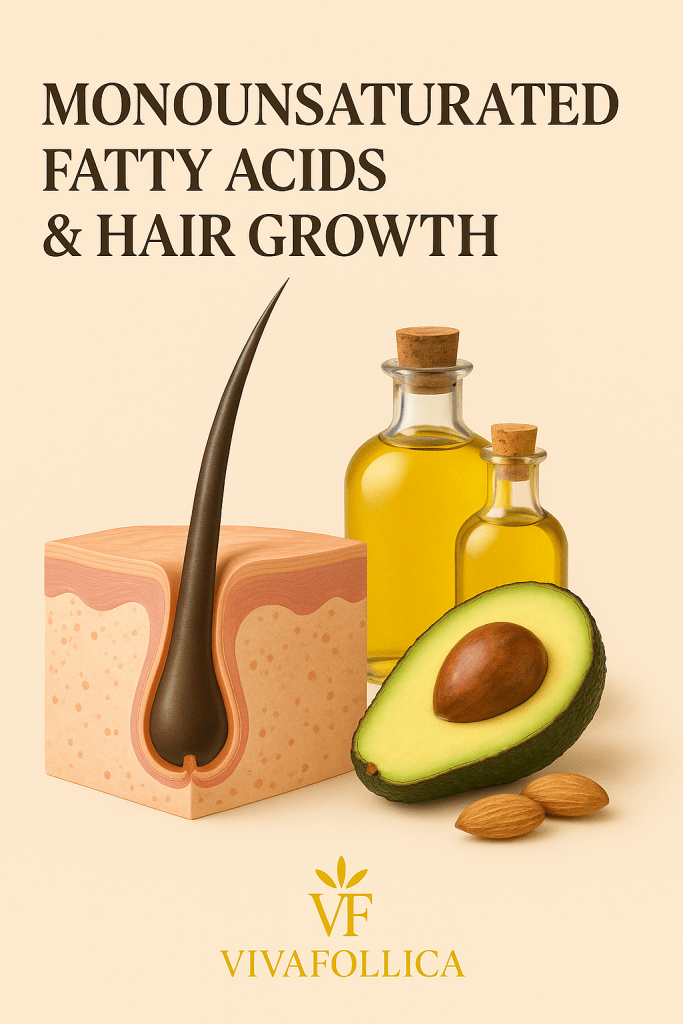
  • How Monounsaturated Fatty Acids Activate Hair Follicles & Support Healthy Growth

    The Science Behind MUFAs — and Why Vivafollica Uses Them

    In recent years, monounsaturated fatty acids (MUFAs) have emerged as powerful allies in the world of scalp health and hair restoration. While most people associate MUFAs with heart-healthy foods like olive oil and avocados, research shows that these fatty acids also play a critical role in activating hair follicles, restoring barrier function, and supporting thicker, healthier hair growth.

    Vivafollica’s serum was intentionally crafted with a high concentration of MUFA-rich botanicals — part of our commitment to using science-driven, nutrient-dense formulations. With ~60% active and nutritional ingredients and 15–20% restorative carrier oils, our formula delivers MUFAs directly to the follicles where they make the biggest impact.

    Let’s break down the science behind why MUFAs matter.

    What Are Monounsaturated Fatty Acids?

    MUFAs are healthy fats found in plant oils like olive, avocado, jojoba, and argan oil. Unlike saturated fats, MUFAs remain fluid at body temperature, which allows them to penetrate the scalp more easily and nourish follicles directly.

    Some of the most hair-beneficial MUFAs include:

    • Oleic Acid
    • Palmitoleic Acid
    • Gadoleic Acid
    • Eicosenoic Acid

    These fats are not just moisturizing — they are biologically active nutrients that help revive dormant follicles.

    How MUFAs Activate Hair Follicles

    The hair follicle is a highly active mini-organ that relies on lipids (fats) for structure, energy, and signaling. MUFAs support follicle activation through several key mechanisms:

    1. They Strengthen the Scalp’s Lipid Barrier

    A healthy scalp barrier keeps moisture in, irritants out, and creates the ideal environment for hair growth. MUFAs repair and replenish the scalp barrier, which calms inflammation and reduces follicular stress.

    A healthier environment = higher follicle activity.

    2. They Improve Micro-Circulation Around the Follicle

    MUFAs help support better blood flow, bringing oxygen and nutrients directly to the root. Improved circulation allows follicles to stay in the anagen (growth) phase longer.

    3. They Activate Stem Cells in the Bulge Region

    The bulge region of the follicle contains stem cells responsible for producing new hair.
    Research suggests that MUFAs enhance the lipid environment that these stem cells rely on, encouraging new growth and regeneration.

    4. They Reduce Inflammation That Blocks Growth

    Chronic inflammation is one of the biggest causes of thinning and shedding. MUFAs have natural anti-inflammatory properties that help soothe the scalp and reduce the inflammatory load around follicles.

    5. They Keep the Hair Shaft Smooth & Flexible

    Healthy sebum naturally contains MUFAs — when this balance is restored through topical application, hair becomes smoother, shinier, and less prone to breakage.

    MUFAs in Vivafollica: Thoughtfully Selected & Clinically Aligned

    Because MUFAs are critical to follicle health, Vivafollica’s serum includes several MUFA-rich botanical oils as part of its 15–20% carrier oil system — each chosen to deliver maximum nourishment without greasiness.

    Examples of MUFA-rich oils in our formula include:

    • Jojoba Oil (rich in eicosenoic & oleic acids, biomimics natural sebum)
    • Argan Oil (high in oleic & linoleic acids — strengthens follicles)
    • Olive-derived Squalane (ultra-light MUFA support for barrier repair)
    • Avocado Oil (oleic acid for deep nourishment & softness)

    These oils do more than moisturize — they deliver targeted lipid nutrition to the follicles.

    Why Vivafollica’s MUFA System Works So Well

    Unlike traditional hair serums that rely on heavy silicones or coated shine, Vivafollica uses nutrient-dense oils that are biologically active, meaning they interact with the follicle instead of sitting on top of the hair.

    Combined with our 60% blend of clinical actives — including Redensyl, Capixyl, Niacinamide, Fo-Ti Root, and Rosemary Extract — MUFAs amplify:

    • Scalp healing
    • Follicle responsiveness
    • Hair strength
    • Shine
    • Smoothness
    • Elasticity

    In other words, MUFAs don’t just make hair look healthier — they support the biology that makes hair grow healthier.

    The Bottom Line: MUFAs Are a Game-Changer for Hair Growth

    A scalp rich in monounsaturated fatty acids is a scalp that can support stronger, denser, shinier hair. By nurturing the follicle environment, calming inflammation, and restoring lipid balance, MUFAs help awaken your follicles and keep them active.

    With Vivafollica’s uniquely concentrated formulation, you’re giving your scalp the nutrients it needs to thrive — naturally.

    Vivafollica: Where Science Meets Clean Beauty

    Healthy shine. Stronger strands. A balanced, nourished scalp.
    It all begins with what you feed your follicles.

  • How to Maintain Shiny, Healthy Hair

    There’s something about shiny hair that instantly signals health, confidence, and vitality. But true shine doesn’t come from a single product — it’s the result of consistent care, balanced nourishment, and a healthy scalp. Whether your hair is straight, wavy, or curly, these simple yet science-backed habits will help you achieve a natural, luminous glow.

    1. Start with Scalp Health

    Healthy shine begins where your hair does — at the scalp. When your scalp is clean, balanced, and free of buildup, it allows your follicles to function at their best.

    Vivafollica Tip: Use a gentle scalp serum or exfoliant once or twice a week to clear impurities and encourage micro-circulation. Ingredients like Niacinamide, Redensyl, and Fo-Ti root help energize the follicles and promote a healthy environment for growth.

    2. Hydrate From Root to End

    Dryness is the enemy of shine. Hair that’s dehydrated looks dull because the cuticle layer lifts, preventing light from reflecting smoothly off the strand.

    Keep your hair hydrated by:

    • Using a moisture-rich conditioner after every wash.
    • Applying a lightweight, non-greasy serum or leave-in treatment to seal in moisture.
    • Drinking enough water — internal hydration reflects externally.

    Vivafollica Insight: Look for ingredients like Panthenol (B5), Hyaluronic Acid, and Capixyl that attract and lock in moisture without weighing hair down.

    3. Protect Your Cuticle Layer

    Your hair’s outer cuticle is like the surface of a mirror — the smoother it is, the shinier your hair appears. Heat, UV exposure, and harsh brushing can roughen the cuticle, scattering light and creating dullness.

    Shine-Saving Tips:

    • Always use a heat protectant before styling tools.
    • Limit hot tools to 1–2 times per week.
    • Rinse hair with cool water after conditioning to help seal the cuticle.
    • Sleep on a silk or satin pillowcase to reduce friction and frizz.

    4. Feed Your Hair Nutrients

    Shine starts from within. Nutrient-dense foods rich in omega-3 fatty acids, zinc, iron, and biotin support glossy, resilient strands.

    Shine-Boosting Foods:

    • Salmon, chia seeds, or walnuts (for healthy fats)
    • Spinach, lentils, and beans (for iron and protein)
    • Berries and citrus fruits (for vitamin C to support collagen)

    A balanced diet supports scalp circulation and strengthens new growth — the foundation for long-term shine.

    5. Avoid Product Buildup

    Even the best products can dull your shine if they accumulate on the scalp or hair shaft. Over time, buildup blocks light reflection and weighs strands down.

    Use a gentle clarifying shampoo once every 1–2 weeks to reset your scalp and hair. If you use oils or dry shampoo often, this step is key to keeping your shine radiant and natural.

    6. Choose “Clean Shine” — Not Coated Shine

    Many conventional serums rely on heavy silicones that create temporary gloss but suffocate the hair shaft over time. Instead, choose clean-beauty formulas that nourish the hair without coating it.

    Vivafollica formulas use science-driven botanicals — like Redensyl, Fo-Ti Root, Niacinamide, and Rosemary Oil — to support healthy growth and hydration so your shine comes naturally, not artificially.

    The Vivafollica Way to Shine

    Shiny hair isn’t just about how it looks — it’s a reflection of how healthy and balanced your scalp and lifestyle are. With consistency, gentle care, and the right products, your hair can regain its natural luminosity and strength.

    Because real shine starts from within — and Vivafollica helps bring it to the surface.

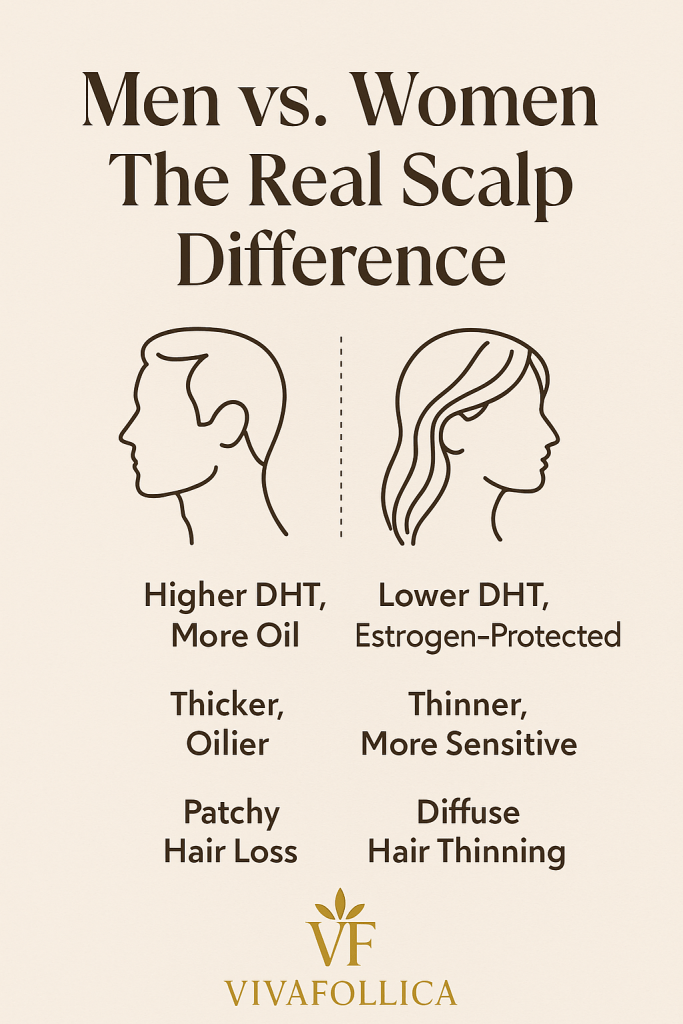
  • Men vs. Women: How Our Scalps Differ — and Why It Matters for Hair Health

    Yes, there are some key biological differences between men’s and women’s scalps, even though they share the same basic structure. These differences explain why men and women often experience different hair thinning patterns, oil production, and scalp needs.

    Here’s a simple breakdown 👇

    1. Hormonal Differences (The Biggest Factor)

    The biggest difference between men’s and women’s scalps comes from hormones — especially androgens like testosterone and its more potent form, DHT (dihydrotestosterone).

    • Men: Have higher levels of DHT, which binds to hair follicles (especially around the crown and hairline) and gradually shrinks them — a process called miniaturization. This is why men typically experience receding hairlines and bald spots.
    • Women: Also have DHT, but in much lower amounts. Estrogen helps balance it out, protecting follicles longer. When estrogen drops (after pregnancy or during menopause), women may see diffuse thinning instead of patchy baldness.

    💬 So, men’s hair loss tends to be concentrated in specific areas, while women’s is usually more spread out.

    2. Oil (Sebum) Production

    Men’s scalps generally produce more sebum (oil) than women’s — up to 50% more in some studies.

    • Men’s scalps: Tend to be oilier, which can lead to clogged pores, buildup, or scalp acne if not washed regularly.
    • Women’s scalps: Usually stay more balanced but can fluctuate due to hormonal changes, stress, or overuse of styling products.

    💡 This is why men often prefer lightweight, purifying scalp care, while women may need more balancing and hydrating formulas.

    3. Skin Thickness and Sensitivity

    • Men’s scalps are typically thicker and have larger pores, which helps with oil flow but can also hold onto buildup.
    • Women’s scalps tend to be thinner and more sensitive, meaning harsh ingredients (like sulfates or alcohols) can cause irritation more easily.

    That’s why women’s scalp care often focuses on gentle nourishment and barrier repair — especially with serums that contain soothing ingredients like Niacinamide, Panthenol, or botanical extracts.

    4. Hair Follicle Density and Growth Cycle

    • Both men and women are born with roughly 100,000 hair follicles, but follicle density (how close together they are) and growth cycles differ slightly.
    • Men’s follicles can have shorter growth (anagen) phases due to DHT influence, meaning hair cycles faster and sheds sooner.
    • Women’s follicles usually stay in the growth phase longer, which is why women’s hair often grows longer before shedding.

    5. Hair Loss Patterns

    FeatureMenWomen
    Common patternReceding hairline, thinning crownWidening part, diffuse thinning
    Hormone involvedHigh DHTDHT + Low estrogen
    When it beginsOften in 20s–30sUsually after 40s or post-pregnancy
    Reversible?PartiallyOften treatable if follicles stay active

    6. Scalp Care Needs

    Because of these differences, ideal scalp care routines aren’t always the same.

    For Men:

    • Use clarifying or balancing shampoos to manage excess oil and buildup.
    • Add DHT-blocking ingredients like Capixyl, Redensyl, or saw palmetto.
    • Exfoliate weekly to keep follicles clear.

    For Women:

    • Use hydrating, gentle cleansers that preserve scalp moisture.
    • Support hormonal balance and follicle strength with ingredients like Fo-Ti RootNiacinamide, and caffeine.
    • Avoid harsh chemicals or tight hairstyles that stress the follicles.

    7. Shared Truth: Healthy Hair Starts with the Scalp

    Even though there are differences, one thing is true for both men and women:

    The scalp is skin — and healthy hair begins with healthy skin.

    Whether it’s controlling oil, soothing irritation, or boosting circulation, both men and women benefit from consistent scalp care that includes:

    • Regular cleansing (to remove buildup)
    • Gentle exfoliation
    • Daily nourishment (like a growth serum)
    • Stress management and balanced nutrition

    💜 In Summary

    AspectMen’s ScalpWomen’s Scalp
    HormonesHigher DHT, more oilLower DHT, estrogen-protected
    Skin typeThicker, oilierThinner, more sensitive
    Hair lossPatchy (crown/hairline)Diffuse (crown/part line)
    Care needsClarifying, anti-DHTHydrating, hormone-supportive

    Vivafollica’s Approach

    At Vivafollica, we design formulas that respect both biology and balance. Our growth serum, powered by Redensyl, Capixyl, Fo-Ti Root, and Niacinamide, targets the root cause of thinning while maintaining scalp health for both men and women.

    Our mission: Where science meets nature — for every scalp. 💜

  • How to Best Remove Product Buildup from Your Scalp

    We focus so much on skincare for our face — but how often do we think about the skin on our scalp? Over time, products like dry shampoo, oils, conditioners, and even natural sebum can build up on the scalp, clogging hair follicles and making it harder for your hair to grow healthy and strong.

    Just like our pores need cleansing, our scalp needs regular detoxing too. If you’ve ever noticed dull roots, flakes, or an itchy, heavy feeling at the crown, you’re likely experiencing scalp buildup — and the good news is, it’s completely treatable.

    Here’s how to recognize scalp buildup, why it happens, and how to safely remove it for a balanced, refreshed, and healthy scalp.

    What Is Scalp Buildup?

    Scalp buildup is a mix of dead skin cells, oil (sebum), sweat, and leftover product residue that accumulates on your scalp over time.

    Every time you apply shampoo, conditioner, leave-in treatments, hairspray, or dry shampoo, a little residue can remain — especially if you don’t wash frequently. Add to that natural oil and pollution, and your scalp becomes coated in a layer that blocks follicles and limits oxygen flow.

    Over time, this buildup can cause:

    • Clogged follicles (leading to hair thinning or slower growth)
    • Flakes and itching (similar to dandruff but not always the same)
    • Oily roots and dry ends
    • Lack of volume or dull appearance
    • Poor serum absorption — meaning your growth treatments can’t fully penetrate the scalp

    Common Causes of Scalp Buildup

    1. Overusing styling products
      Gels, creams, sprays, and serums can all leave behind residue. Silicone-based products are especially known for coating the scalp.
    2. Not washing often enough
      If you wash every 3–5 days (or longer), oils and product layers can combine to form a film over your scalp.
    3. Hard water
      Minerals in hard water bind with shampoo residue, making it difficult to rinse cleanly.
    4. Improper shampooing technique
      Applying shampoo only to hair strands — instead of focusing on the scalp — can leave the skin underneath unclean.
    5. Heavy oils or butters
      While nourishing, natural oils like coconut or castor oil can be hard to wash out fully and may clog pores if overused.

    How to Tell if You Have Scalp Buildup

    You might have buildup if you notice:

    • waxy or sticky feeling near the roots
    • Flakes or dryness even after washing
    • Itchiness or irritation
    • Hair that feels flat or lifeless
    • A white residue when you scratch your scalp gently with your nail

    If that sounds familiar, your scalp likely needs a reset.

    How to Remove Scalp Buildup — Safely and Effectively

    The goal isn’t to strip your scalp completely — it’s to deep clean while maintaining balance. Here’s how to do it properly:

    1️⃣ Start with a Clarifying Shampoo

    A clarifying shampoo is specially formulated to dissolve residue from oils, silicones, and styling products.

    Look for:

    • Sulfate-free or gentle surfactants
    • Ingredients like salicylic acidapple cider vinegar, or activated charcoal

    🪶 How to use:

    • Apply to wet hair and massage directly into your scalp for 1–2 minutes.
    • Rinse thoroughly and follow with a lightweight conditioner, focusing only on the ends.
    • Use once every 1–2 weeks — not daily, as overuse can dry the scalp.

    💜 Pro tip: If you use growth serums like Vivafollica’s Follicle Revival Serum, always clarify your scalp first so your treatment can absorb better.

    2️⃣ Exfoliate with a Scalp Scrub

    Just like facial exfoliation, your scalp benefits from gentle physical or chemical exfoliation.

    Options include:

    • Sugar or salt scrubs with botanical oils (like jojoba or tea tree)
    • Chemical exfoliants with glycolic acid or lactic acid, which dissolve dead skin

    🪶 How to use:

    • Apply scrub to a damp scalp before shampooing.
    • Massage gently in circular motions — don’t scratch with your nails.
    • Rinse thoroughly and follow with shampoo and conditioner.

    This helps lift buildup, boost circulation, and leave your scalp feeling refreshed.

    3️⃣ Try a Scalp Detox Treatment

    Scalp detoxes are lightweight liquids or masks that help rebalance pH and break down oil.

    DIY options:

    • Apple cider vinegar rinse: Mix 1 part ACV with 3 parts water and pour over your scalp after shampooing. Leave for 2–3 minutes, then rinse.
    • Aloe vera gel: Calms irritation and moisturizes while cleansing residue.

    Professional options:

    • Scalp detox sprays or serums with witch hazeltea tree, or salicylic acid.

    4️⃣ Massage the Scalp Regularly

    Massage encourages lymphatic drainage and circulation, which helps move waste products away from follicles.

    🪶 How to do it:

    • Use fingertips or a silicone scalp brush.
    • Massage in small circular motions for 2–3 minutes daily.
    • Can be done before bed, especially when applying a serum like Vivafollica.

    A healthy scalp = stronger roots and faster growth.

    5️⃣ Avoid Heavy Product Layering

    Once your scalp is clean, keep it that way by simplifying your routine.

    Try this clean, effective order:

    1. Clarify or exfoliate (1x weekly)
    2. Hydrate with a gentle, balanced shampoo and conditioner
    3. Apply serum or treatment directly to scalp (daily or nightly)
    4. Use styling products lightly, focusing on ends instead of roots

    Look for non-comedogenic, lightweight formulas that won’t clog follicles or weigh hair down — especially if you don’t wash every day.

    The Vivafollica Approach: Clean Scalp, Healthy Hair

    At Vivafollica, we believe scalp health is skin health.
    Our hair growth philosophy combines clean beauty + clinical science, ensuring ingredients like Redensyl, Capixyl, Fo-Ti Root, Niacinamide, and caffeine can do their best work — free from buildup and blockage.

    That’s why we recommend pairing your serum routine with a gentle detox ritual once a week to keep your follicles clear and receptive.

    When your scalp can breathe, your hair can thrive. 🌿

    Removing scalp buildup isn’t about harsh stripping — it’s about restoring balance. By cleansing gently, exfoliating regularly, and nourishing afterward, you’ll help your follicles perform their best and support thicker, shinier, more resilient hair.

    Remember: a clean scalp is the foundation of beautiful hair.
    Start small, stay consistent, and your scalp (and strands) will thank you. 💜